back
to Farmer Fred home page
Tree of the Week
Western Redbud & Eastern
Redbud
(Cercis occidentalis, Cercis
canadensis)
The redbuds put on their best show in late
winter/early spring in the Sacramento and San Joaquin valleys,
producing the flowers before the tree produces leaves. The eastern
redbud is better used as a tree in the home garden. The western
redbud tends to be a smaller and more shrub-like, and is better
suited to a naturalized area, sharing space with other drought
tolerant plants.
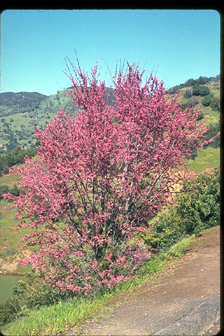
Western Redbud
Here are some details about the Western
redbud:
- A California native of the legume family, also
known as the Judas tree (Easter time, coral red flowers may
resemble the blood of Christ).
- Natural stands occur at 1,000-4,000 feet, in
the Sierra Nevada and Coast Ranges.
- A member of the legume family, the tree
produces 2-1/2" seed pods in summer and fall that persist on the
tree throughout the winter. Refrigerate seed for 90 days at 40
degrees before planting.
- Medium rate of growth, to 18 feet, with an
8-15 feet spread.
- Coral red flowers, 1/2" across, in early
spring.
- Likes, dry well-drained soil. Very little
water needed in summer.
- Takes arid conditions, sun and
heat.
- Hardy to 0 degrees.
- Pest problems: caterpillars, leaf
blight.
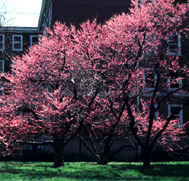
Eastern Redbud
Here are some details about the Eastern
redbud:
- Deciduous, broadleaf tree, of the legume
family
- Medium to rapid growth, 25-30 feet tall, with
a 20-25 feet spread
- 1/2" rosy pink flowers in early
spring
- 3-inch seed pods in the fall (refrigerate at
40 degrees for 90 days before planting)
- Likes full sun, hardy to 0 degrees
- Water deeply every three weeks during growing
season
- The 'Alba' cultivar has white
flowers